AI is quickly becoming part of project management, business analysis, software delivery, automation, reporting, and digital transformation.
That sounds exciting.
But it also creates a dangerous illusion.
Many companies are starting to believe that if they add AI tools to their workflow, their projects will automatically become faster, cheaper, and smarter.
That is not how technology works.
AI can help a strong project team move faster.
It can help a skilled project manager produce better analysis, clearer documentation, stronger meeting notes, cleaner risk logs, and faster stakeholder updates.
But AI cannot fix a project that has no clear goal.
It cannot save a team that does not understand the business problem.
It cannot replace leadership that refuses to make decisions.
And it cannot rescue a technology initiative where nobody agrees on what success actually means.
This is why the future of project management is not just “learning AI.”
The future belongs to professionals who understand how AI, business, people, process, and delivery fit together.
Basically, AI Is Changing the Work, Not the Need for Judgment.
A project manager used to spend hours writing meeting notes, preparing status reports, cleaning up action items, updating trackers, and summarizing long conversations.
AI tools can now help with many of these tasks.
For example, a project manager can use AI to:
Summarize meeting transcripts, draft stakeholder updates, create project charters, identify risks from notes, compare vendor responses, generate test scenarios, organize requirements, and turn messy business conversations into clearer delivery documents.
That is powerful.
But there is a difference between producing project documents and managing a project.
AI can help write a risk; it cannot decide whether the risk is politically sensitive.
AI can summarize a meeting; tt cannot always tell when the most important thing in the meeting was what nobody said.
AI can draft a project plan; tt cannot fully understand that one stakeholder has influence beyond their title, or that a deadline is unrealistic because the team is already exhausted.
That is where human judgment still matters.
In fact, as AI makes documentation easier, judgment becomes even more important.
The weak project manager may use AI to produce more content.
The strong project manager will use AI to produce better clarity.
Bringing It Home; The Real Problem With Many Tech Initiatives
Most failed technology initiatives do not fail because nobody had access to tools.
Often, the issue was unclear thinking.
Or the business problem was never defined properly.
Or the requirements kept changing because stakeholders were not aligned.
Or the project plan looked good, but the assumptions underneath it were weak.
Or the team was busy, but not necessarily moving toward the right outcome.
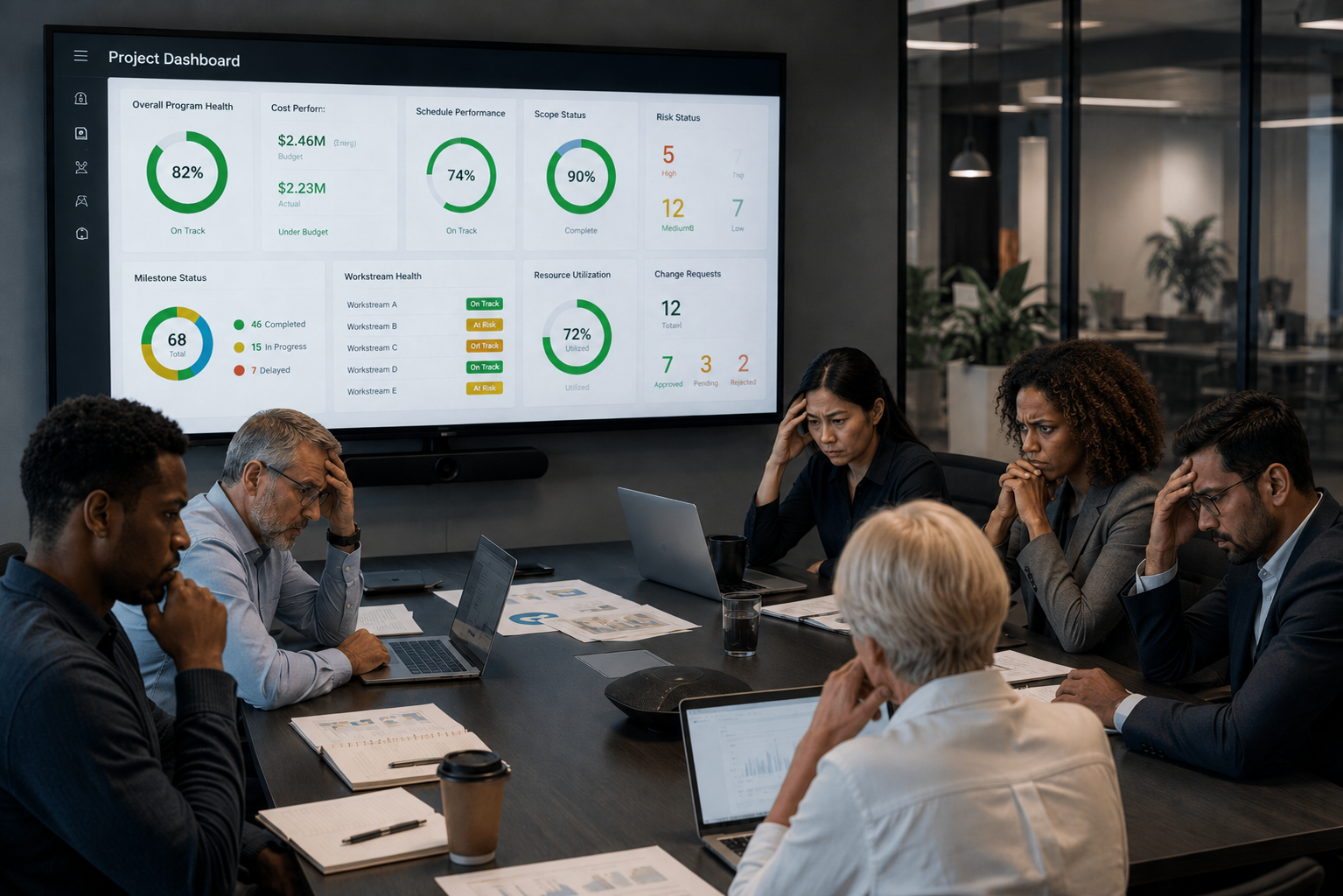
Or (and a big one) the dashboard was green, but the conversations behind the dashboard were not honest.
AI does not automatically solve those problems.
If anything, AI can make them harder to see.
A team can now generate polished documents, clean presentations, detailed plans, and professional-looking reports faster than ever.
But polished does not mean true.
A beautiful project plan built on weak assumptions is still a weak project plan.
A detailed AI-generated requirements document is still dangerous if nobody validated the real business need.
A confident executive summary is still misleading if the project team is quietly uncertain.
This is why professionals in project management, program management, business analysis, and corporate technology need more than tool knowledge.
They need delivery thinking.
What AI Means for Project Managers and Business Analysts
Facts: AI will not remove the need for project managers, program managers, and business analysts.
But it will change what good looks like.
The value of a project manager will move away from simply maintaining trackers and sending updates.
The value will be in asking better questions, spotting weak assumptions, managing stakeholder tension, understanding business outcomes, and using AI tools to accelerate the work without losing control of the thinking.
The value of a business analyst will move away from just documenting requirements.
The value will be in understanding the business process, identifying gaps, validating what users actually need, and using AI to organize complexity into something teams can act on.
The value of a program manager will move away from simply collecting status from multiple projects.
The value will be in connecting risks across initiatives, seeing patterns across teams, and helping leaders make better decisions before problems become expensive.
AI can support all of this.
But only if the professional using AI understands the work deeply enough to guide it.